
Introduction
Electrical systems are among the most critical and potentially dangerous components of any building. A failing circuit, an overloaded panel, or a faulty connection can lead to fires, equipment damage, or serious injury. The goal of this guide is to give you a clear, practical process for inspecting a residential or light commercial electrical system from top to bottom.
This guide is written for three audiences. Homeowners who want to understand the condition of their home’s wiring before buying, selling, or renovating. Licensed home inspectors who need a structured checklist to work through during a standard inspection. Electricians who want a reference document to share with clients or use as a field guide on unfamiliar properties.
An electrical inspection should be performed every 10 years in a typical home, every 3 to 5 years in a home older than 25 years, before purchasing any existing property, after any major renovation or addition, and after a significant weather event such as flooding or lightning.
| Important Disclaimer: This guide is intended as an educational resource and a starting point for inspection. It does not replace the judgment of a licensed electrician. Any defect flagged during an inspection should be evaluated and repaired by a qualified professional before the system is used. |
Safety Precautions Before You Begin
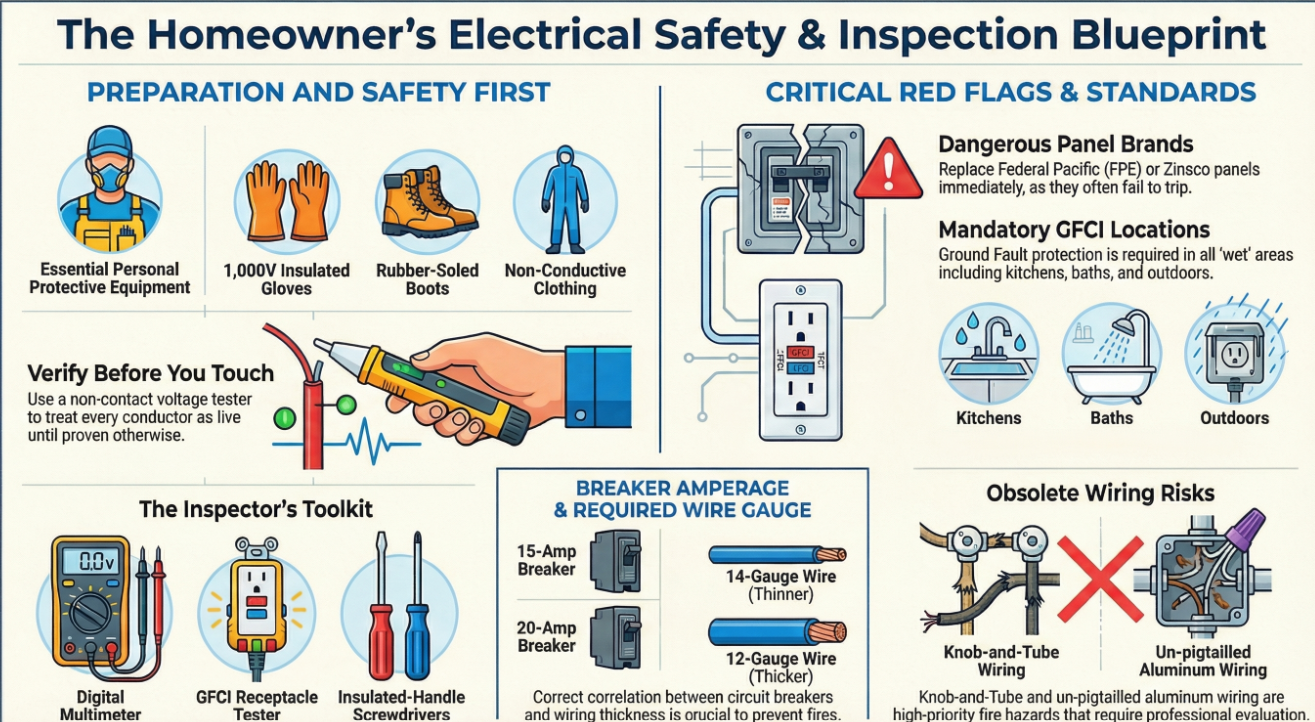
Before touching any part of an electrical system, you need to make sure you are protected. Electrical hazards can cause burns, cardiac arrest, and death. Taking a few minutes to prepare properly is not optional.
Personal Protective Equipment
You should wear the following items whenever you are near live electrical components:
- Rubber-soled insulated boots rated for electrical work
- Safety glasses or a full face shield
- Insulated gloves rated at a minimum of 1,000 volts
- Non-conductive clothing with no metal zippers, buttons, or accessories
Tools You Will Need
- Non-contact voltage tester
- Digital multimeter
- Receptacle tester with GFCI function
- Flashlight or headlamp
- Flathead and Phillips screwdrivers with insulated handles
- Circuit tracer or tone generator
- Notepad or inspection report form
Working Near Live Panels
Never work inside a live panel without the proper training and tools. If you are a homeowner or general inspector, your role is to observe, not to touch live conductors. You can open the dead front cover of a panel to examine breakers and wiring, but the main lugs at the top of most panels remain energized even when the main breaker is off. Treat every conductor as live until you have confirmed otherwise with a tester.
| WARNING: Never reach behind the dead front cover of a main service panel without first confirming the service conductors are de-energized by the utility. These wires cannot be shut off at the breaker. |
Emergency Procedures
Post emergency contacts at the property before you begin. You should have the number for the local utility company, local fire department, and poison control in case of chemical burns from batteries or corroded components. If someone receives an electrical shock, do not touch them while they are still in contact with the source. Cut power at the main breaker first, then call emergency services immediately.
Electrical Panel Inspection
The electrical panel is the heart of the system. It receives power from the utility, distributes it to individual circuits, and provides overcurrent protection through breakers or fuses. A thorough panel inspection will reveal many of the most serious defects in any electrical system.
Main Service Panel Condition
Start by locating the main service panel. It should be in a dry, accessible location with at least 3 feet of clear working space in front of it. The panel door should open fully and latch securely. The outer enclosure should show no signs of rust, corrosion, or physical damage.
Remove the dead front cover and examine the interior. Look for signs of heat damage such as melted wire insulation, discolored metal, or a burning smell. Inspect the bus bars for corrosion, which appears as green or white powdery buildup on the copper or aluminum. Any of these conditions require immediate attention from an electrician.
Breaker Labeling and Sizing
Every circuit breaker in the panel should be clearly labeled with the area or appliance it serves. Unlabeled breakers are a safety issue because they make it impossible to quickly cut power in an emergency. If labels are missing or unclear, take the time to trace and label each circuit.
Breaker sizing must match the wire gauge of the circuit it protects. The most common pairing is a 15-amp breaker with 14-gauge wire and a 20-amp breaker with 12-gauge wire. An oversized breaker cannot protect the wire from overheating, which is one of the leading causes of electrical fires.
Common Panel Defects
- Double-tapped breakers: Two wires connected to a single breaker terminal, which is a code violation in most cases
- Tandem breakers in panels not rated for them
- Federal Pacific Electric or Zinsco panels, which are known to fail to trip under fault conditions
- Aluminum branch circuit wiring connected to devices not rated for aluminum
- Missing knockouts on the enclosure, which allow pests and moisture to enter
- Breakers that feel loose or do not click firmly into position
GFCI and AFCI Breakers
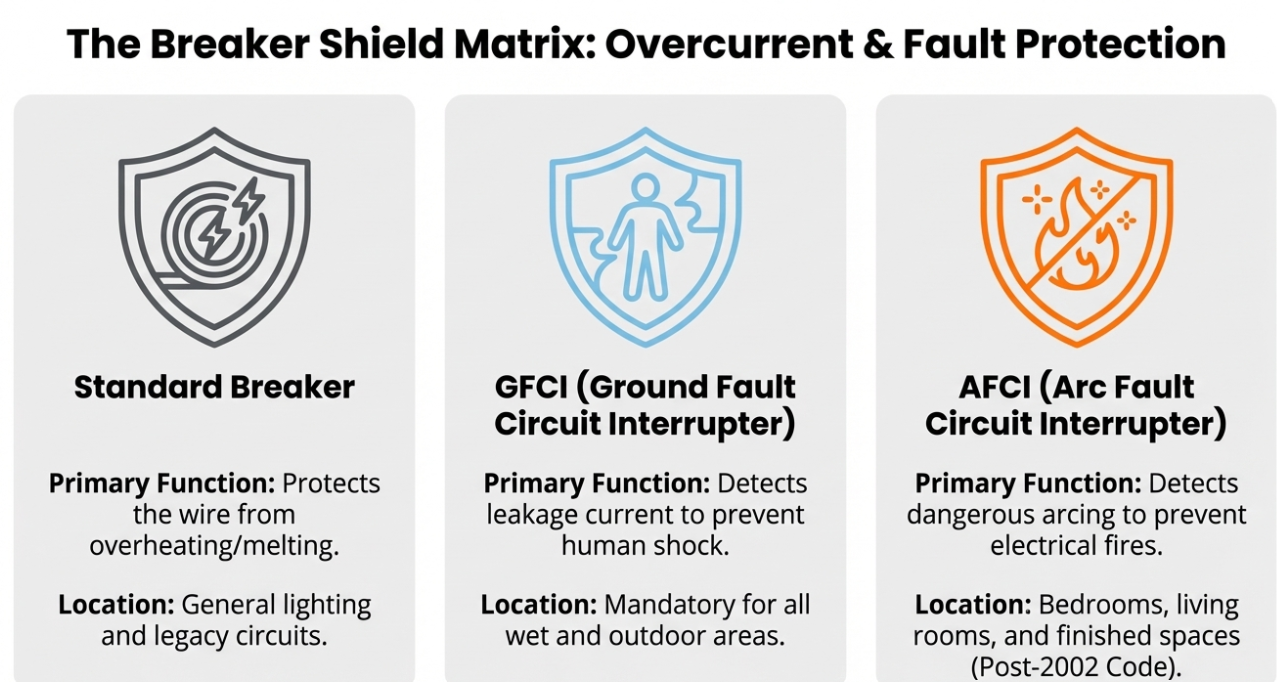
Ground Fault Circuit Interrupter breakers protect against shock by detecting small leakage currents. Arc Fault Circuit Interrupter breakers protect against fires by detecting dangerous arcing in wiring and devices. Modern codes require AFCI protection on most bedroom and living area circuits and GFCI protection on any circuit serving wet areas. Older homes may lack these protections entirely, which is a finding worth documenting and addressing.
Wiring and Circuits
The wiring that runs through the walls, ceilings, and floors carries current from the panel to every outlet, switch, and fixture in the building. Inspecting it thoroughly requires looking in attics, basements, crawlspaces, and utility areas where wiring is often exposed and easier to evaluate.
Identifying Wiring Types
The type of wiring in a home tells you a great deal about its age and potential hazards.
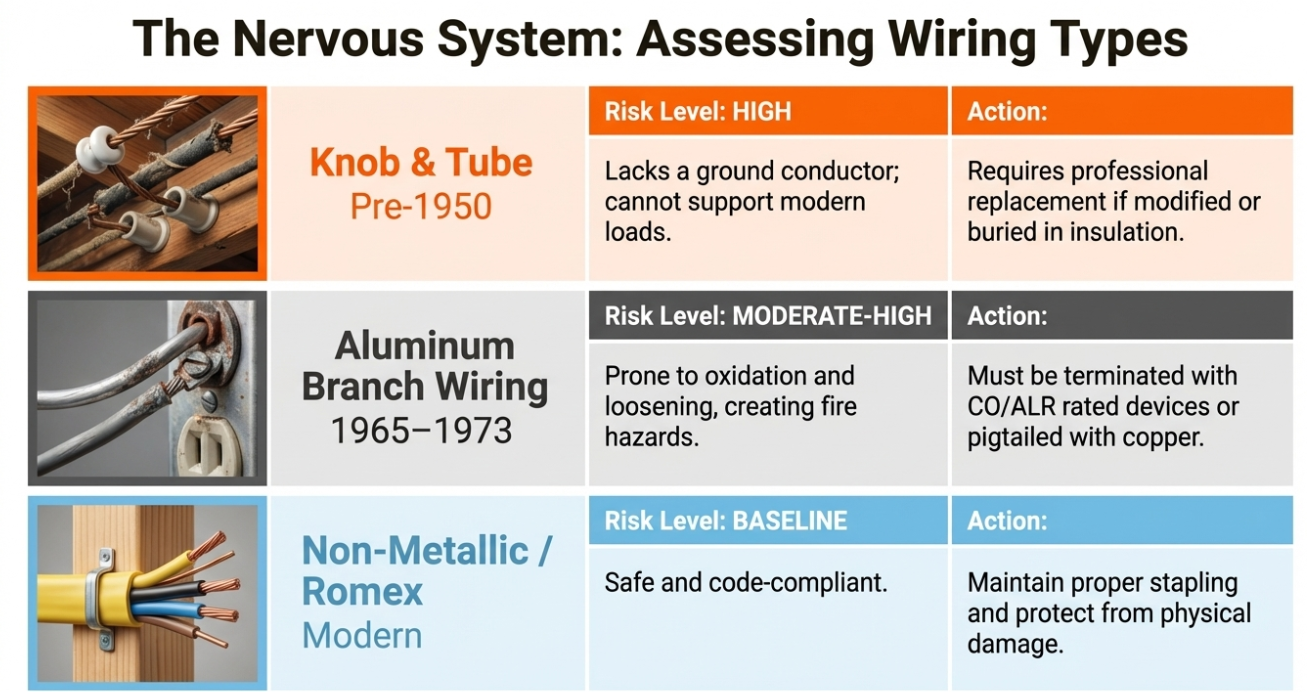
- Non-metallic sheathed cable (NM or Romex): The most common modern wiring type. Safe and code-compliant when properly installed.
- Armored cable (BX or MC): Metal-sheathed wiring common in older urban construction. Generally safe but should be checked for damage.
- Aluminum branch circuit wiring: Used widely in homes built between 1965 and 1973. Prone to loosening at connections and oxidation, both of which create fire hazards. Must be properly terminated with CO/ALR rated devices or pigtailed with copper wire.
- Knob-and-tube wiring: Found in homes built before 1950. Lacks a ground conductor and cannot safely support modern electrical loads. Typically requires replacement if discovered.
Signs of Damaged or Improper Wiring
- Cracked, brittle, or missing insulation on conductors
- Wiring run through areas of high heat such as near flues, chimneys, or heating equipment without proper protection
- Wire stapled too tightly, which can damage insulation over time
- Conductors run without protection through open floor or ceiling joists in accessible spaces
- Extension cords used as permanent wiring
Junction Boxes and Splices
All wire connections must be made inside a covered junction box. Connections made in open air, inside walls without a box, or in areas that are not accessible for future inspection are code violations. Every junction box must have its cover plate in place. Open junction boxes are both a shock hazard and a fire hazard.
Outlets, Switches, and Fixtures
Outlets and switches are the parts of the electrical system that occupants interact with every day. They are also the most likely components to show wear, damage, and improper installation.
Outlet Condition and Grounding
Every outlet should be tested with a receptacle tester. A properly wired grounded outlet will show two illuminated lights on most standard testers. An open ground means the ground wire is missing or disconnected. Reversed polarity means the hot and neutral wires are swapped, which makes some devices dangerous to use.
Ungrounded two-prong outlets in older homes cannot be simply replaced with three-prong outlets unless a ground is added or a GFCI device is installed in its place. Replacing an ungrounded outlet with a three-prong outlet without either of these remedies is a code violation that puts users at risk.
GFCI Outlet Placement
GFCI protection is required at outlets in the following locations in most jurisdictions: all bathroom outlets, all kitchen countertop outlets within 6 feet of a sink, all garage outlets, all unfinished basement outlets, all outdoor outlets, and outlets near pools, hot tubs, and wet bars. A single GFCI outlet can protect all downstream outlets on the same circuit when wired correctly.
AFCI Protection
Current code requires AFCI protection on circuits serving bedrooms, living rooms, dining rooms, hallways, and most other finished living spaces. This protection can be provided at the breaker panel with an AFCI breaker or at the first outlet on a circuit with an AFCI outlet device. Homes built or renovated after 2002 in most jurisdictions should have some degree of AFCI protection.
Switches and Fixtures
- All switch and outlet cover plates should be in place, undamaged, and flush with the wall surface
- Switches should operate smoothly with a positive click and should not feel warm to the touch
- Ceiling fans and light fixtures should be mounted to boxes rated for their weight
- Fixtures should not show signs of overlamping, which is using bulbs with higher wattage than the fixture is rated for
- Recessed lights in insulated ceilings must be rated for insulation contact
Grounding and Bonding
Grounding and bonding are two related but distinct concepts that together keep people safe during fault conditions. Grounding provides a path for fault current to return to the source and trip the breaker. Bonding connects all conductive metal parts together so they remain at the same voltage potential and do not create a shock hazard between them.
Grounding Electrode System
The grounding electrode system connects the electrical system to the earth. It typically consists of a ground rod driven at least 8 feet into the soil, water pipe connections, or a concrete-encased electrode. The grounding electrode conductor runs from the main panel to the grounding electrodes and must be protected from damage and remain continuous.
Bonding Requirements
- All metal water piping that could become energized must be bonded
- Metal gas piping near electrical equipment must be bonded
- Metal ductwork in contact with electrical equipment must be bonded
- Structural steel in commercial applications must be bonded
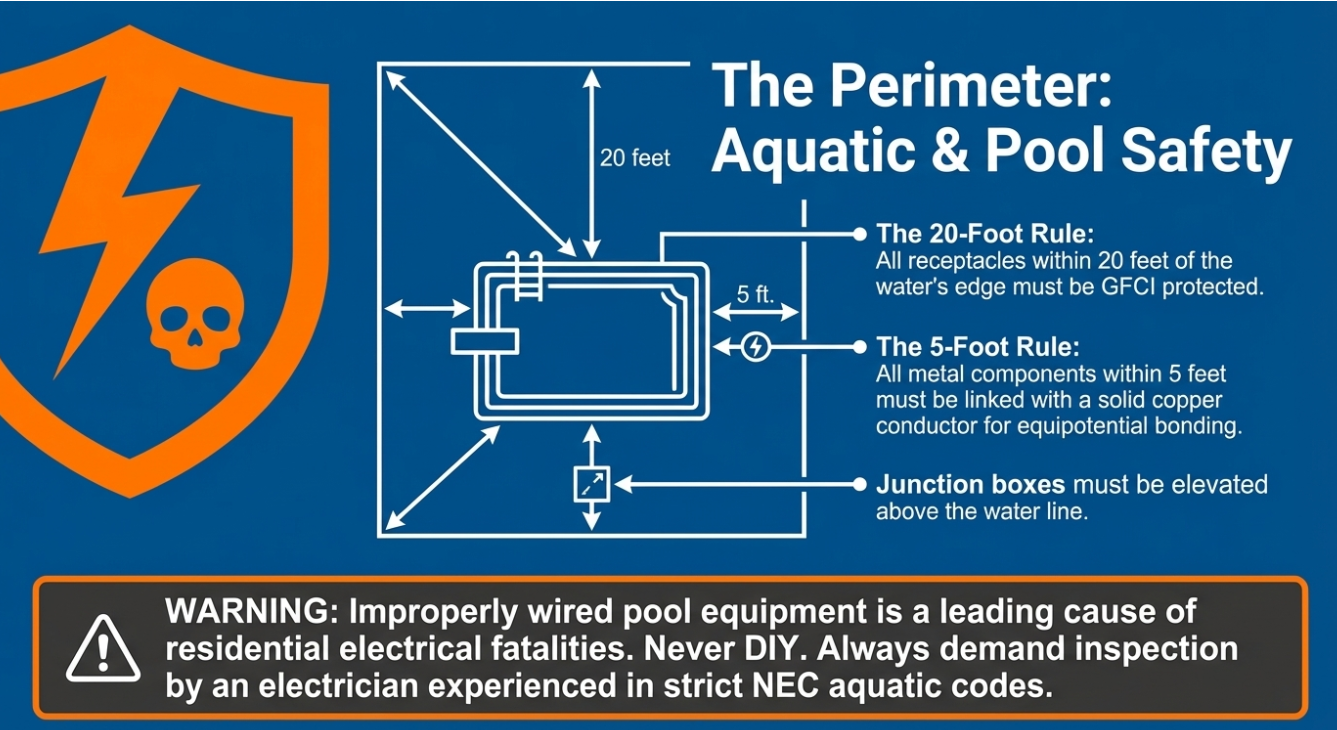
- Pool and spa equipment requires equipotential bonding of all metal components within 5 feet
Exterior and Special Systems
Exterior electrical installations face unique challenges because they are exposed to weather, temperature extremes, and physical damage. Special systems including EV chargers, solar panels, and pool equipment all have specific code requirements that must be verified separately.
Outdoor Outlets and Weatherproofing
All outdoor outlets must be GFCI protected and installed in weatherproof enclosures. Outlets exposed to the weather while in use require an in-use cover, sometimes called an extra-duty cover, that keeps the outlet protected even with a cord plugged in. Standard weatherproof covers that require a plug to be removed before closing the cover are not acceptable for outlets likely to have cords left plugged in for extended periods.
EV Charger Installation
Level 2 electric vehicle chargers require a dedicated 240-volt circuit with proper amperage for the charger being installed. Most home chargers require a 50-amp circuit, though some can operate on 40 or 30 amps. The circuit must be protected by a breaker sized at 125 percent of the charger’s rated current draw. Outdoor chargers must be listed for outdoor use and mounted in a weatherproof location.
Pool, Spa, and Hot Tub Safety
Pool and spa electrical systems are subject to some of the most detailed requirements in the National Electrical Code. All receptacles within 20 feet of the pool edge must be GFCI protected. Lighting fixtures must be listed for underwater or wet location use and installed at specific depths. All metal components within 5 feet of the pool must be bonded together with a solid copper conductor. Junction boxes near pools must be elevated above the water line and located at a minimum distance from the pool edge.
| WARNING: Pool and spa electrical work is among the most dangerous residential electrical work. Improperly wired pool equipment has caused numerous deaths. Always have pool electrical systems inspected and repaired by an electrician with experience in aquatic installations. |
Solar Panel Systems
- Verify that a disconnect is accessible and labeled near the meter
- Check that conduit runs from panels to inverter are secured and protected
- Confirm the inverter is UL listed and properly ventilated
- Review interconnection agreement with the utility for compliance
- Check for anti-islanding protection on the inverter
Common Defects and Red Flags
Some findings during an inspection call for monitoring and future repair. Others demand that the system be evaluated by a licensed electrician before it is used. The following are the defects that inspectors and electricians encounter most often and that carry the greatest risk.
High Priority Defects Requiring Immediate Action
- Active Federal Pacific Electric Stab-Lok or Zinsco panels: These panels have documented failure rates and should be replaced
- Knob-and-tube wiring that has been modified, buried in insulation, or used to serve high-load appliances
- Aluminum branch circuit wiring with improper terminations
- Unprotected wiring in areas accessible to pests or subject to physical damage
- Signs of arcing or burning inside any electrical enclosure
- Any junction box that is permanently buried inside a wall or ceiling
Moderate Defects Worth Documenting
- Missing GFCI or AFCI protection where currently required by code
- Unlabeled breakers or circuits
- Double-tapped breakers
- Open knockouts in panels or junction boxes
- Outlets without cover plates
- Extension cords run under carpets or through walls
DIY Wiring Errors
Unpermitted and amateur wiring repairs are extremely common in homes that have changed hands multiple times. The most frequent DIY errors include wires connected outside of boxes, mismatched wire gauges on a single circuit, reversed polarity on outlets, missing ground connections, and breakers replaced with the wrong amperage. All DIY wiring should be evaluated by a licensed electrician, particularly if there is any doubt about whether it was done correctly.
Inspection Checklist (Printable Summary)
Use the following checklist during your inspection. Mark each item as Pass, Needs Attention, or Immediate Action required.
Panel and Service
| Inspection Item | Pass | Attention | Immediate |
| Panel accessible with 3 ft of clearance | |||
| Panel enclosure free of rust or damage | |||
| All breakers labeled clearly | |||
| No double-tapped breakers | |||
| No signs of overheating or burning | |||
| GFCI breakers present where required | |||
| AFCI breakers present where required | |||
| Main grounding electrode conductor intact | |||
| No open knockouts in enclosure | |||
| Panel brand is not FPE or Zinsco |
Wiring and Circuits
| Inspection Item | Pass | Attention | Immediate |
| No exposed or damaged wiring visible | |||
| No knob-and-tube wiring in use | |||
| Aluminum branch wiring properly terminated | |||
| All junction boxes covered | |||
| No splices made outside of boxes | |||
| Wire gauges match breaker ratings | |||
| No extension cords used as permanent wiring |
Outlets and Switches
| Inspection Item | Pass | Attention | Immediate |
| All outlets test with correct polarity and grounding | |||
| GFCI outlets present in bathrooms | |||
| GFCI outlets present in kitchen | |||
| GFCI outlets present in garage and basement | |||
| GFCI outlets present outdoors | |||
| All cover plates in place | |||
| Switches operate smoothly, not warm to touch | |||
| Light fixtures mounted to rated boxes | |||
| No overlamping observed |
Exterior Systems
| Inspection Item | Pass | Attention | Immediate |
| Outdoor outlets have in-use weatherproof covers | |||
| Outdoor outlets are GFCI protected | |||
| Service entrance cable secured and undamaged | |||
| EV charger on dedicated circuit if present | |||
| Solar disconnect accessible and labeled | |||
| Pool or spa equipment properly bonded |
After the Inspection
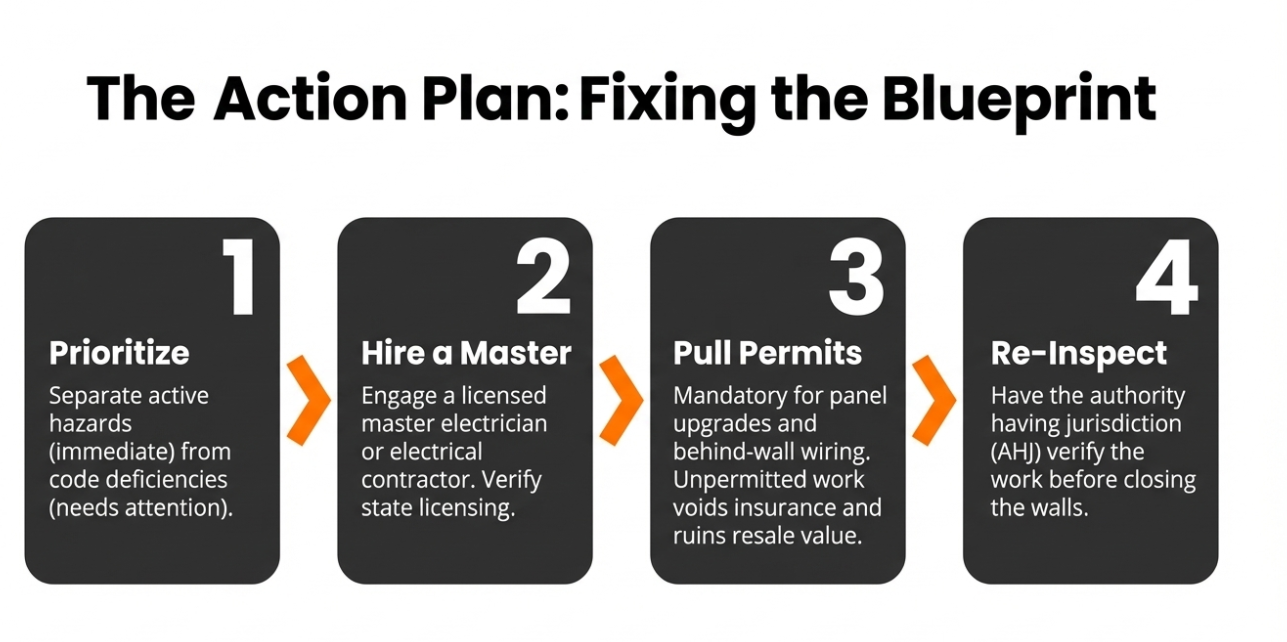
An inspection report is only useful if you act on what you find. After completing your walkthrough, take a few minutes to organize your findings and create a clear action plan.
Prioritizing Repairs
Not every finding requires immediate action. Sort your findings into three categories. Items in the immediate action category are conditions that pose an active fire or shock hazard. These should be addressed before the home is occupied or before electrical use continues in the affected area. Items in the needs attention category are code deficiencies or deteriorating conditions that should be corrected within a reasonable timeframe, typically within 90 days to a year. Items in the monitor category are conditions that are not yet defects but that should be checked again at the next inspection.
Hiring a Qualified Electrician
When hiring an electrician to address findings from your inspection, look for a licensed master electrician or a licensed electrical contractor in your state or jurisdiction. Verify their license status with your state licensing board. Ask for a written estimate that describes the scope of work clearly. Ask whether the work will be permitted and inspected, because unpermitted electrical work can create problems when you sell the property and may not be covered by insurance if it is later identified as the cause of a fire or injury.
Permits and Code Compliance
Most electrical repairs beyond simple device replacements require a permit and inspection by the local authority having jurisdiction. This includes panel replacements, service upgrades, new circuits, and any wiring work inside walls. The permit process exists to ensure that work is inspected by a qualified official before it is closed up inside walls. Skipping the permit process saves time upfront but creates significant problems later.
Re-inspection Recommendations
- Request a re-inspection after any major repairs are completed
- Schedule your next routine inspection within 3 to 5 years for homes over 25 years old
- Re-inspect after any flooding, lightning strike, or major storm damage
- Re-inspect whenever you add a new major appliance, EV charger, or significant electrical load
Appendix
Glossary of Electrical Terms
| AFCI | Arc Fault Circuit Interrupter. A device that detects dangerous arcing in a circuit and shuts it off to prevent fires. |
| Bonding | The process of connecting all conductive metal parts in a system so they remain at the same electrical potential. |
| Dead Front | The protective cover on a panel that conceals live conductors while allowing access to the breakers. |
| GFCI | Ground Fault Circuit Interrupter. A device that detects small leakage currents and shuts off power to prevent shock. |
| Grounding | A connection from the electrical system to the earth that provides a path for fault current. |
| Knob-and-Tube | Early 20th century wiring method using ceramic knobs and tubes to route unsheathed conductors. |
| Overcurrent | A condition in which more current flows through a conductor than it is rated to carry. |
| Service Entrance | The point where utility power enters the building, consisting of the service conductors and meter. |
| Tandem Breaker | A breaker that fits two circuits into a single breaker slot. Only acceptable in panels rated for them. |
Key NEC Code References
- NEC Article 110: General requirements for electrical installations
- NEC Article 210: Branch circuits, including GFCI and AFCI requirements
- NEC Article 230: Services
- NEC Article 250: Grounding and bonding
- NEC Article 310: Conductors for general wiring
- NEC Article 680: Swimming pools, fountains, and similar installations
- NEC Article 690: Solar photovoltaic systems